
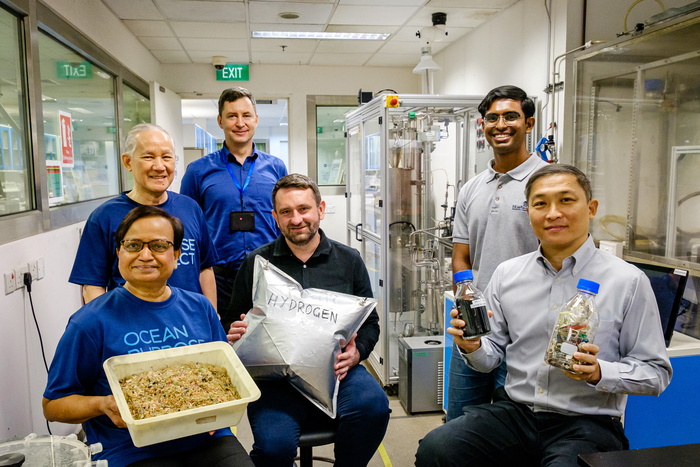
Bluefield Renewable Energy Collaborates with Nanyang Technological University (NTU) to develop several proprietary IPs
Bluefield Renewable Energy is proud to announce its collaboration with scientists from Nanyang Technological University, Singapore (NTU Singapore). This innovative project utilizes pyrolysis, a high-temperature chemical process. One of the developments is to address the global issue of plastic pollution while creating valuable resources. On this vector, Bluefield Renewable Energy is collaborating with Ocean Purpose Project in a groundbreaking initiative to convert ocean plastic waste into clean hydrogen fuel and carbon nanotubes.
Advancing Pyrolysis Technology with NTU
The research team at NTU, led by Associate Professor Grzegorz Lisak from the Nanyang Environment and Water Research Institute (NEWRI), is working to refine this conversion method and assess its commercial feasibility. The project is being test-bedded on the NTU Smart Campus to treat local plastic waste, in partnership with Bluefield Renewable Energy, which specializes in mobile waste-to-resources technologies. Supported by the Industry Alignment Fund-Industry Collaboration Projects (IAF-ICP) and administered by Singapore’s Agency for Science, Technology and Research (A*STAR), this multimillion-dollar joint project aims to develop scalable solutions for converting waste plastics into hydrogen over the next three years.
Turning Plastic Waste into Hydrogen and Carbon Nanotubes
Unlike PET plastic bottles, which are easily recyclable, plastic litter such as contaminated food packaging, styrofoam, and plastic bags is difficult to recycle and often ends up in landfills or incinerators, causing significant environmental harm. Through pyrolysis, these challenging plastics can be transformed into hydrogen and solid carbon products, such as carbon nanotubes. Hydrogen produced in this way is an excellent fuel for generating electricity and powering fuel cells in electric vehicles, with clean water as its only by-product.
Exploring Decentralized Waste Management
The project will also explore the potential of other emerging technologies for decentralized waste management, including the conversion of challenging waste streams into energy and valuable resources such as syngas, biochar, activated carbon, and carbon nanotubes. With 832 million kilograms of unrecycled plastic waste generated annually in Singapore, the energy produced from this conversion could potentially power up to 1,000 five-room apartments for a year.
About Nanyang Technological University, Singapore
A research-intensive public university, Nanyang Technological University, Singapore (NTU Singapore) has 33,000 undergraduate and postgraduate students in various colleges. NTU is home to world-renowned autonomous institutes and leading research centres such as the Nanyang Environment & Water Research Institute (NEWRI) and Energy Research Institute @ NTU (ERI@N). Ranked among the world’s top universities, NTU is committed to harnessing the power of digital technology and tech-enabled solutions to support better learning and living experiences, the discovery of new knowledge, and the sustainability of resources. For more information, visit www.ntu.edu.sg.
Bluefield Renewable Energy’s Commitment
Bluefield Renewable Energy highlighted the importance of this collaboration: “During this pandemic, the increase in plastic usage has been substantial, with many opting for takeaways and grocery shopping in plastic containers. Current recycling methods are insufficient, leading to environmental contamination. Our flexi-pyrolysis system allows us to convert these environmentally unfriendly plastic waste streams into valuable resources. This collaboration with NTU NEWRI expands our technological applications and promotes the commercialization of locally created innovations, ultimately establishing Singapore as a central resource hub.”
Partnership with Ocean Purpose Project
Marine litter collected from local waters, in collaboration with the Ocean Purpose Project, serves as the research material for developing this efficient plastic waste-to-hydrogen process. With an estimated 269 million kilograms of plastic waste currently floating in the oceans, the NTU team believes that converting this waste into energy could power an electric vehicle for 20 to 40 million kilometers – equivalent to 500 to 1,000 times the Earth’s circumference.
Community Engagement and Sustainability
The collaboration extends beyond technological innovation. Last November, NEWRI researchers participated in Race For Oceans Singapore, a kayak race organized by the Ocean Purpose Project, to collect plastic waste along Singapore’s shores. This initiative aimed to clean up marine litter through community engagement and use the collected litter as research material.
Ms. Mathilda D’silva, CEO and Founder of Ocean Purpose Project, emphasized the significance of this initiative: “Our collaboration with NTU NEWRI comes at a critical time when we need to rethink how plastics are recycled in Asia. The innovative approach of converting plastics into hydrogen fuel could be a game-changer in removing ocean pollution at scale.”
Future Prospects
The solid carbon produced from this new conversion process is much easier to store compared to gaseous CO2 emissions from plastic waste incineration. Additionally, the solid carbon can be sold as a manufacturing feedstock for specialty chemicals or biofuels, providing a greener source of carbon for making carbon nanotubes used in various industrial applications.
If successful, this initiative will help reduce the total amount of waste disposed of in Singapore, extending the lifespan of Semakau Landfill, which is projected to run out of space by 2035. This research collaboration aligns with NTU’s commitment to sustainability, as outlined in its Sustainability Manifesto, which aims to reduce waste, water, and energy consumption by 50% by 2026 and achieve carbon neutrality.
Bluefield Renewable Energy is proud to be at the forefront of this transformative project, showcasing the potential of converting waste into valuable resources and contributing to a cleaner, more sustainable future. As the world pivots towards a hydrogen-powered economy, this collaboration stands as a testament to the power of innovation and the importance of addressing environmental challenges through advanced technology and strategic partnerships.
Speak to us today to discuss potential collaborations with BRE.